Free
€0
No account, no ads.
Included:
- All of A1 and A2, with every word
- Perfekt, Präteritum and Wechselpräpositionen
- Every adjective ending
- Feedback, progress and widgets
 Deklinoo
Deutsch
Get the app
Fill in the gaps in real German sentences, A1 to B1, and see why whenever you’re wrong. Works offline, no account needed.

Soon on Google Play
Article
Article
Wo?
DativeEs liegt auf dem Tisch.
Wohin?
AccusativeIch lege es auf den Tisch.
Pronouns
Pick a chapter to see a sample card. Every task is a German sentence with a gap.
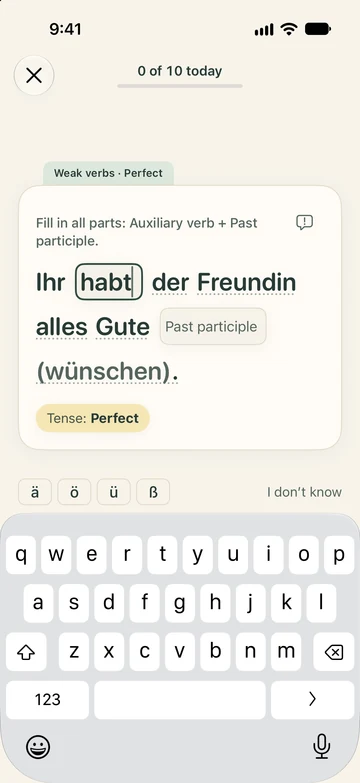
Ihr habt der Freundin alles Gute gewünscht.
You wished your friend all the best.
| ich | habe gewünscht |
|---|---|
| du | hast gewünscht |
| er/sie/es | hat gewünscht |
| wir | haben gewünscht |
| ihr | habt gewünscht |
| sie/Sie | haben gewünscht |
The app also drills Präsens, Präteritum, Futur I, Imperativ, Konjunktiv I and II, and which preposition a verb takes.
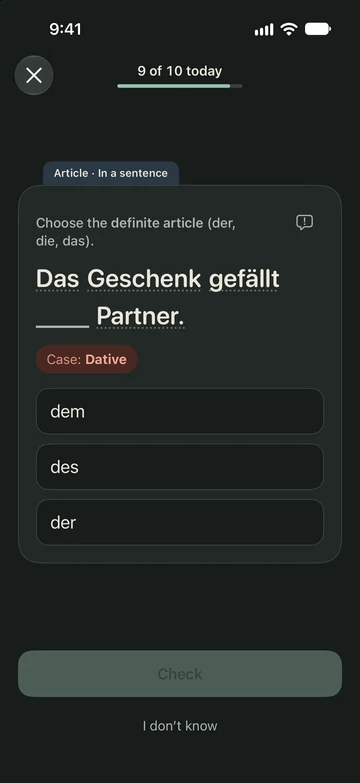
Das Geschenk gefällt dem Partner.
The partner likes the present.
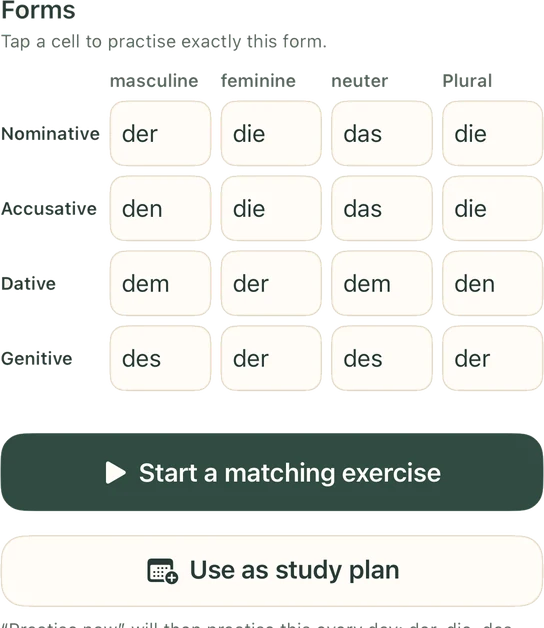
| masculine | feminine | neuter | plural | |
|---|---|---|---|---|
| Nominative | der | die | das | die |
| Accusative | den | die | das | die |
| Dative | dem | der | dem | den |
The app also drills ein, kein, mein and dieser, and the Genitiv.
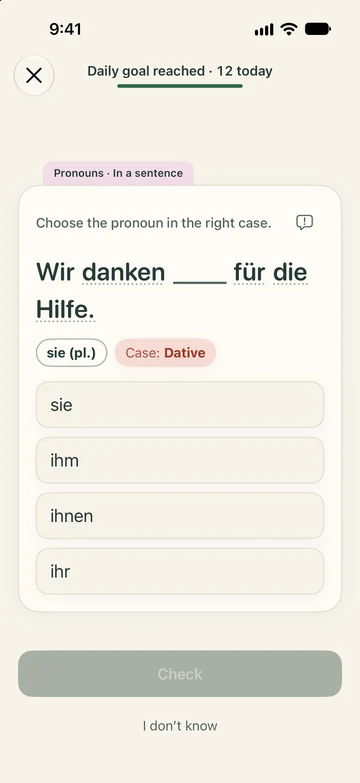
Wir danken ihnen für die Hilfe.
We thank them for the help.
| Nominative | Accusative | Dative |
|---|---|---|
| ich | mich | mir |
| du | dich | dir |
| er | ihn | ihm |
| wir | uns | uns |
| sie (Pl.) | sie | ihnen |
The sentence decides the case: the verb or preposition tells you.
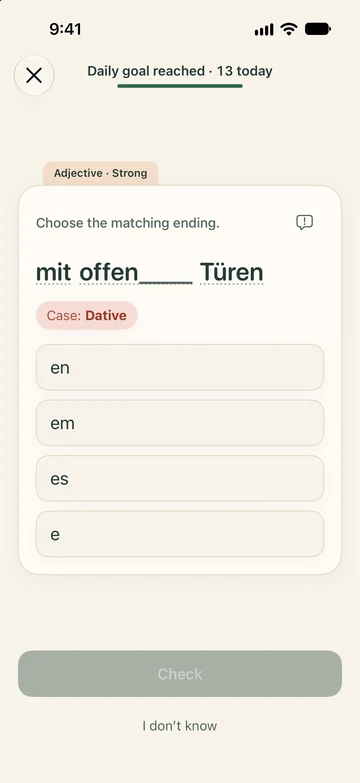
mit offenen Türen
with open doors
| masculine | feminine | neuter | plural | |
|---|---|---|---|---|
| Nominative | offener | offene | offenes | offene |
| Accusative | offenen | offene | offenes | offene |
| Dative | offenem | offener | offenem | offenen |
The app also drills the endings after der, die, das and after ein, kein, mein.
Hints stay hidden until you ask for them.
Almost. Take another look at the form.
Correct form
derdie Tochterdaughter
We’re talking to the daughter.
Your answer: dem
“dem” is used in the dative with masculine or neuter nouns. “die Tochter” is feminine.
mit is always followed by the dative. Dative, feminine: “der Tochter”.
Article in a sentence
Choose the definite article (der, die, das).
Ich dankedankento thank gapder Studentindie Studentinstudent (female).
Correct.
Correct form
derdie Studentinstudent (female)
I'm thanking the student.
danken takes the dative (whom am I thanking?). dative, feminine: “der Studentin”.
Almost. Take another look at the form.
Correct form
derdie Studentinstudent (female)
I'm thanking the student.
Your answer: dem
“dem” is used in the dative with masculine or neuter nouns. “die Studentin” is feminine.
danken takes the dative (whom am I thanking?). dative, feminine: “der Studentin”.
Almost. Take another look at the form.
Correct form
derdie Studentinstudent (female)
I'm thanking the student.
Your answer: die
“die” is the form for the nominative or accusative (feminine). Here the dative is needed.
danken takes the dative (whom am I thanking?). dative, feminine: “der Studentin”.
Almost. Take another look at the form.
Correct form
derdie Studentinstudent (female)
I'm thanking the student.
Your answer: den
“den” is the plural form. The singular is asked for.
danken takes the dative (whom am I thanking?). dative, feminine: “der Studentin”.
Pronouns in a sentence
Choose the pronoun in the right case.
Wir dankendankento thank gapihnen fürfürfor diedie Hilfehelp Hilfedie Hilfehelp.
sie (pl.) Case: Dative
Correct.
Correct form
ihnen
We thank them for the help.
danken takes the dative (Wem danken wir?). dative of “sie (pl.)”: “ihnen”.
Almost. Take another look at the form.
Correct form
ihnen
We thank them for the help.
Your answer: sie
“sie” is the nominative or accusative form. The dative is needed here: “ihnen”.
danken takes the dative (Wem danken wir?). dative of “sie (pl.)”: “ihnen”.
Almost. Take another look at the form.
Correct form
ihnen
We thank them for the help.
Your answer: ihm
danken takes the dative (Wem danken wir?). dative of “sie (pl.)”: “ihnen”.
Almost. Take another look at the form.
Correct form
ihnen
We thank them for the help.
Your answer: ihr
danken takes the dative (Wem danken wir?). dative of “sie (pl.)”: “ihnen”.
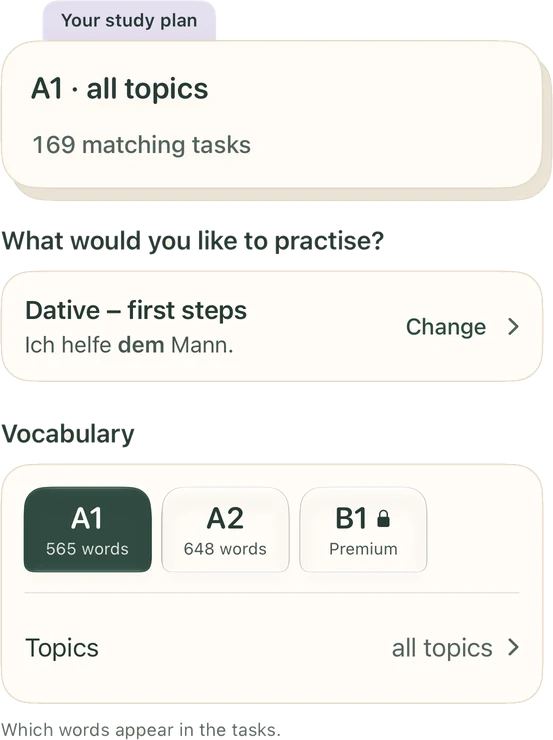
“Where or where to?” instead of grammar terms.
Forms you got wrong come back in your next practice. Forms you know wait longer each time.
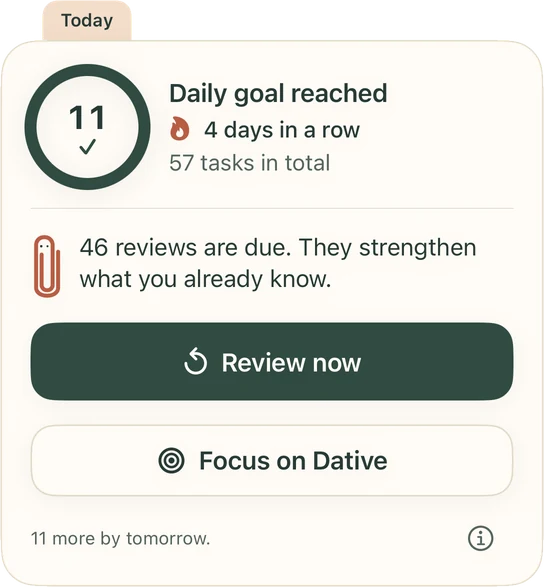
You can open the app and start straight away, with no account. It works offline, except for the optional Premium voice, and if you want sync it runs through your own iCloud.
Crash reports are only sent if you switch them on. There are no ads and no tracking, and this website sets no cookies either.
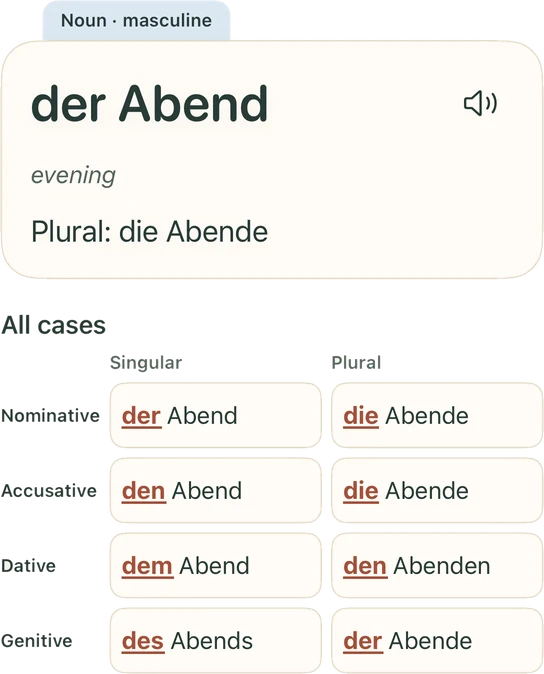
The dictionary comes with it: 1,695 words with all their forms, and the rule behind every card.
Soon on Google Play